
HLNet: Hybrid Learning Network via Implicit Relationship Construction for Spatial-Spectral Super-resolution
Introduction
The architecture of our proposed HLNet is engineered as a three-stage pipeline designed to progressively refine image quality. The process commences within the Dense Feature Exactor (DFE), which establishes a foundational set of spatial and spectral characteristics from the source image. Subsequently, the Hybrid Feature Learning Module (HLM) takes on the crucial task of modeling the intricate interplay between these hybrid features while simultaneously elevating their spatial resolution to the desired scale. Finally, the synthesis of the output image is handled by our novel Hybrid Feature Reconstruction Module (HRM), which focuses on enforcing spectral coherence across distant bands to yield a more precise and detailed hyperspectral image. To ensure this outcome, the entire network is guided by a custom-designed interval loss function that specifically penalizes spectral disparities between non-adjacent bands, a constraint tailored to the unique nature of hyperspectral data.
Environment
- python=3.8
- torch=2.1.1
Get Start
Use HLNet training:
python main.py --mode=1 --batchSize=8 --save_folder=[your model's save_folder] --upscale_factor=2
Use HLNet testing:
python main.py --mode=0 --nEpochs=[your model's epoch] --save_folder=[your model's save_folder] --upscale_factor=2 --outputpath=[your output_folder]
(E.g python main.py --mode=0 --nEpochs=43 --save_folder='./TrainedNet/' --upscale_factor=2 --outputpath='./Output/')
Results
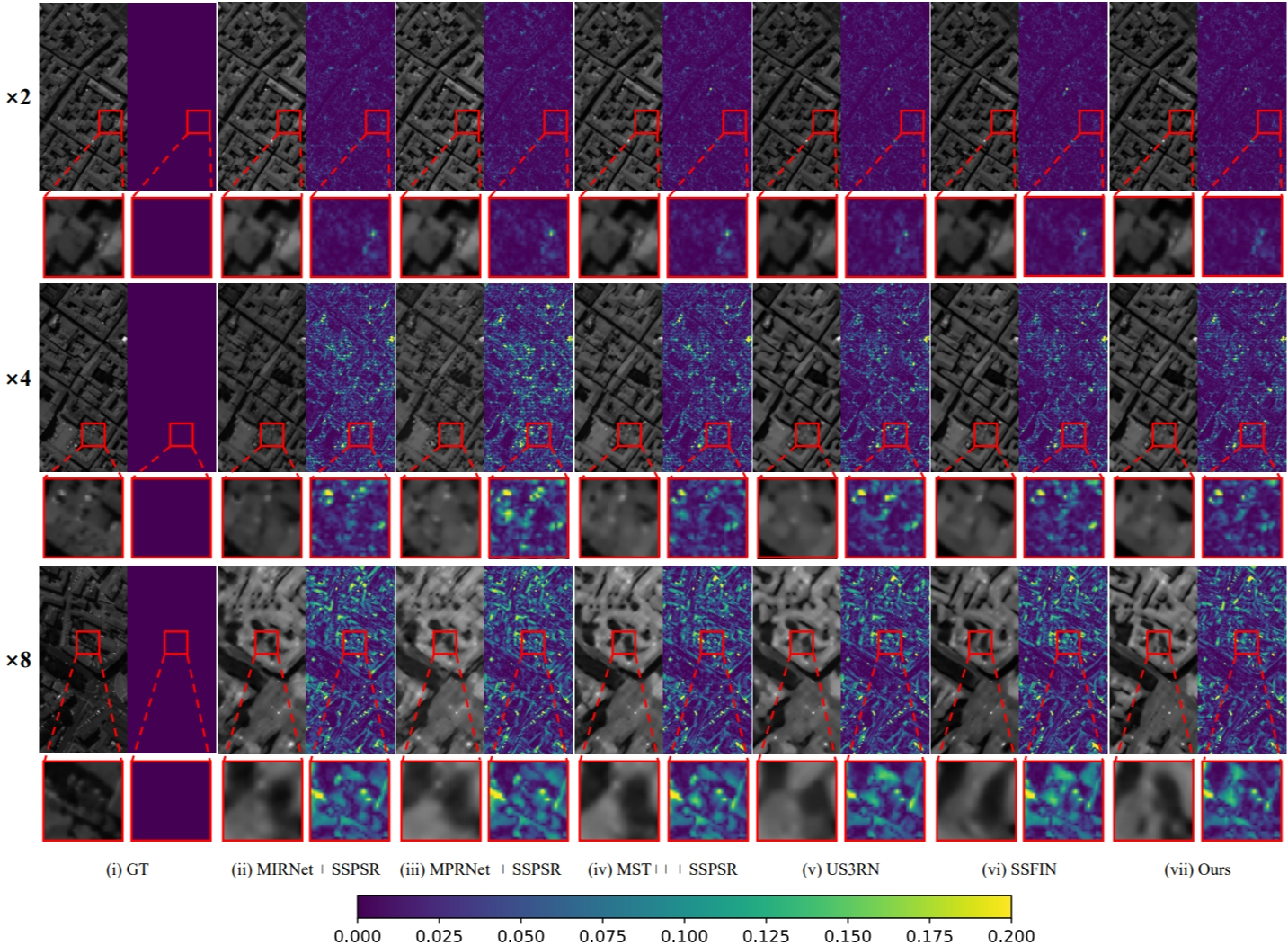
Code
Get the source code from Github, click here.