
HLNet: Hybrid Learning Network via Implicit Relationship Construction for Spatial-Spectral Super-resolution
In the field of remote sensing, images that possess both high spatial and high spectral resolution hold immense potential for various applications. However, acquiring such high-resolution hyperspectral images (HR-HSI) directly is exceptionally challenging due to hardware limitations. Conventional methods typically address this by processing spectral reconstruction and spatial super-resolution sequentially, an approach that ignores the intrinsic correlation between spatial and spectral features. To solve this problem, we propose a unified framework called the Hybrid Learning Network (HLNet), which synergistically learns these two feature properties to achieve joint spatial-spectral super-resolution (SSSR). The network first extracts initial spatial and spectral characteristics using a Dense Feature Extractor (DFE), then employs our Hybrid Feature Learning Module (HLM) to deeply explore the associations between features while mapping them to the target spatial scale. Finally, to enhance spectral fidelity, our novel Hybrid Feature Reconstruction Module (HRM) establishes and utilizes dependencies between long-range spectral bands to finely reconstruct the final HR-HSI, a process further refined by our innovative interval loss function. Experimental results on three public hyperspectral datasets show that our model outperforms existing methods and can be effectively applied to remote sensing imagery. Notably, on the PAVIA CENTRE dataset, our method's PSNR value improved by 0.38 dB over the second-best approach in the 8x super-resolution task.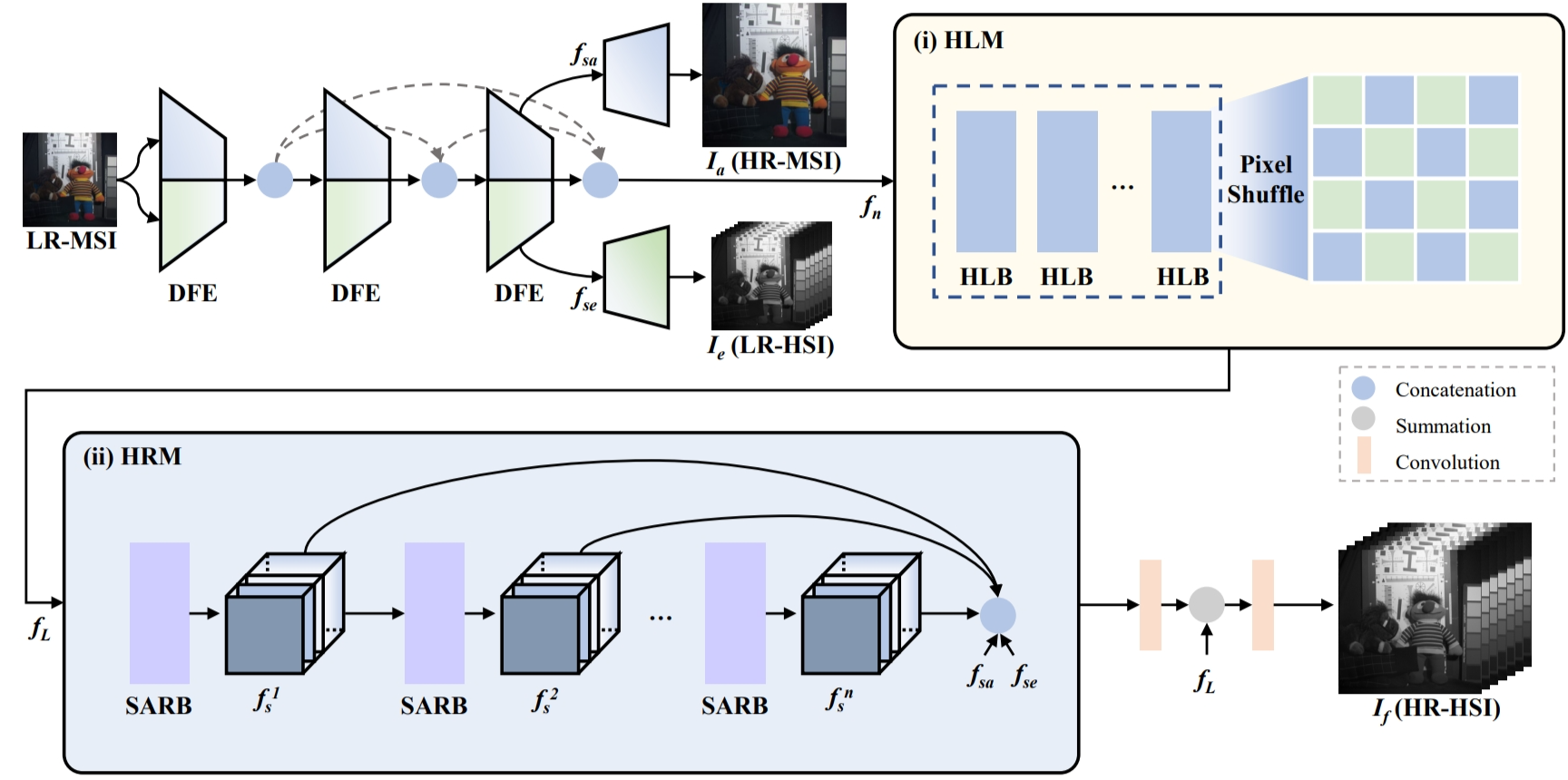
An illustration of the proposed Hybrid Learning Network (HLNet). The key modules detailed are (i) the Hybrid Feature Learning Module (HLM) and (ii) the Hybrid Feature Reconstruction Module (HRM).